

The mortgage landscape has fundamentally shifted. With rising interest rates and increasingly restrictive conventional guidelines, the straightforward deals that once filled your pipelines are becoming harder to find.
Borrowers who would have sailed through automated underwriting systems just a few years ago are now hitting roadblocks—not because they lack creditworthiness, but because they don’t fit the rigid boxes that Fannie Mae and Freddie Mac require.
This is where Non-Qualified Mortgage (Non-QM) lending becomes not just relevant, but essential for today’s mortgage professionals.
Why “Non-Qualified” Doesn’t Mean “Non-Quality”—and How It Can Save Your Fallout Deals
Let’s dispel a persistent myth right away: Non-QM is not subprime lending. We’re often working with borrowers who have excellent credit scores, substantial assets, and strong financial profiles.
So what’s the difference? They’re entrepreneurs, real estate investors, foreign nationals, or self-employed professionals whose income doesn’t follow traditional W-2 patterns that are well-recognized in the mortgage space.
For mortgage brokers, avoiding the Non-QM space means leaving significant revenue opportunities on the table. Non-QM expertise serves as a powerful relationship builder with real estate agents—successfully closing complex deals that other brokers couldn’t handle often leads to referrals for conventional transactions as well.
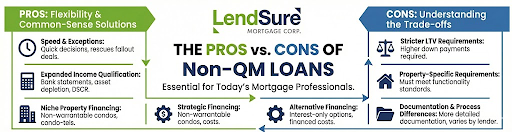
The Pros: Flexibility and Common-Sense Solutions
1. The “Fallout” Savior: Speed and Exceptions When You Need Them Most
The most immediate advantage of Non-QM lending is its ability to rescue deals that conventional lenders reject, often just days before closing. These fallout scenarios create some of the most valuable opportunities in our business—desperate borrowers, grateful Realtors, and the chance to demonstrate expertise when it matters most.
At LendSure, our “common sense” exception process sets us apart from algorithm-driven decision making. Senior management reviews complex scenarios and can often provide decisions within 24-48 hours. This human element allows us to see opportunities where automated systems only see risk.
Consider a scenario where a borrower’s conventional loan was denied because the condo project required mandatory clubhouse membership—a detail that triggered an automated decline. We could review the scenario, determine the requirement does not materially impact the property’s marketability, and close the loan in up to 14 days. That kind of practical underwriting saves deals and builds lasting relationships.
2. Expanded Income Qualification: The Advantage of Combining Mortgage Products
Traditional lending relies heavily on W-2 income verification, which excludes millions of creditworthy borrowers. Non-QM programs open multiple pathways for income documentation:
Bank Statement Programs allow self-employed borrowers to qualify using 12-24 months of personal or business account activity, often with expense ratios as low as 10%. This approach recognizes that tax returns may not reflect a borrower’s true earning capacity, particularly for business owners who maximize deductions.
Asset Depletion Programs serve high-net-worth borrowers who are asset-rich but appear income-poor on paper. LendSure’s 60-month draw period effectively doubles the qualifying income compared to traditional asset depletion calculations, making this program particularly powerful for retirees or trust beneficiaries.
DSCR (Debt Service Coverage Ratio) Loans qualify borrowers based solely on property cash flow, eliminating personal income verification entirely. This approach works exceptionally well for experienced real estate investors building portfolios.
What makes LendSure’s approach unique is our ability to combine these income types. Unlike many lenders who restrict borrowers to a single income documentation method, we can stack W-2 income with asset depletion or blend business and personal bank statements to maximize qualifying power.
3. Niche Property Financing: Where Conventional Lenders Say No
Certain property types create automatic declines with conventional financing, regardless of borrower strength:
Non-Warrantable Condos include properties with ongoing litigation, high commercial space ratios, or concentrated ownership patterns. These projects often house creditworthy borrowers in desirable locations, but fail to meet agency guidelines through no fault of the individual unit or buyer.
Condo-tels represent hybrid properties that function as both condominiums and hotel units. Popular in resort markets like Park City, Las Vegas, and Florida, these properties generate rental income but require specialized financing expertise.
4. Strategic Financing Structures
Non-QM programs offer financing structures that provide competitive advantages:
Interest-Only Options can extend for up to 10 years on 40-year total terms, significantly reducing monthly payments and improving cash flow for investment properties or borrowers managing multiple obligations.
Financed Points and Broker Compensation allow borrowers to roll closing costs into the loan amount while potentially securing better rates. This strategy reduces cash-to-close requirements while improving the overall financing package—a significant competitive advantage when borrowers are shopping with multiple lenders.
The Cons: Understanding the Trade-offs
1. Stricter LTV Requirements
Non-QM lending requires more substantial down payments than conventional financing. You won’t find 97% LTV options here—higher risk profiles demand more borrower equity to protect all parties involved.
Typical maximum LTVs range from 75-80% for most programs, though this can decrease based on risk layering. High-rise condos in certain markets (such as Las Vegas Strip properties) or properties with multiple risk factors may see LTVs drop to 65% or lower.
2. Property-Specific Requirements
Not every property qualifies for Non-QM financing. Properties must meet basic functionality standards:
Size Requirements typically mandate a minimum of 600 square feet, ensuring the property functions as a residence rather than a hotel room.
Kitchen Functionality requires working cooking facilities (cooktop, sink, refrigerator) rather than just mini-fridges or coffee stations.
However, LendSure’s common-sense approach allows for exceptions when the overall scenario makes sense. We’ve successfully funded properties as small as 475 square feet in Park City when borrowers demonstrated strong reserves and the property layout supported residential use.
3. Documentation and Process Differences
Non-QM loans require more detailed documentation and borrower education. Income calculation methods must be explained clearly, particularly for asset depletion or bank statement programs where qualifying income may differ significantly from actual monthly receipts.
Processing timelines may extend beyond conventional loans, though this varies significantly by lender and program type.
Why Partner with LendSure
The decision to embrace Non-QM lending isn’t just about expanding your product menu—it’s about positioning yourself as the broker who solves problems when others can’t. This expertise builds referral relationships that extend far beyond individual transactions.
Our Pre-Underwrite Process eliminates guesswork. Submit borrower scenarios (credit profile, income structure, assets) and receive vetted approval guidance before investing time in full applications. This upfront clarity protects your time and sets proper expectations.
Direct Access means you work with Account Executives and decision-makers, not automated portals. Complex scenarios require human expertise, and our team provides the consultation that makes deals work.
Marketing Support includes private-label materials and social graphics that help you pitch these niche capabilities to real estate partners. Being able to say “I can finance condo-tels” or “I work with foreign nationals” differentiates you in competitive markets.
Your Next Step
Have a deal that just fell out of conventional financing? Contact your LendSure Account Executive to review the scenario. Our common-sense underwriting approach often finds solutions where algorithms see only obstacles.
The Non-QM space represents one of the fastest-growing segments in mortgage lending, driven by borrowers who don’t fit traditional molds but bring substantial assets and creditworthiness to the table. According to industry data, Non-QM loan originations have grown significantly as conventional guidelines have tightened. By developing expertise in this area, you’re not just saving individual deals—you’re building a sustainable competitive advantage in an evolving market.
Visit our Broker Resources page to access our complete webinar library and marketing materials that help you communicate these opportunities to your referral network. In today’s mortgage environment, the brokers who thrive are those who solve problems others can’t. Non-QM lending gives you the tools to be that problem-solver.
Frequently Asked Questions
Do I need broker approval before discussing scenarios with LendSure?
Broker approval requirements vary by transaction type. For investment properties, approval is required before funding and takes 48-72 hours. Contact your Account Executive to confirm requirements for specific scenarios, as owner-occupied and other transaction types may have different timelines or approval processes.
How do I identify Non-QM opportunities?
Look for these indicators: self-employment with significant business write-offs, multiple investment properties (especially near the 10-property Fannie/Freddie cap), foreign nationals without U.S. credit history, recent credit events with strong compensating factors, or asset-rich borrowers without traditional income documentation. If a borrower says “I was told I can’t qualify,” that’s often a Non-QM opportunity.
What’s the difference between Non-QM and subprime?
Non-QM focuses on borrowers who don’t fit agency guidelines due to income documentation or property type—not credit quality. Most of our borrowers have strong credit scores and substantial assets. They’re business owners, real estate investors, or foreign nationals with complex financial profiles that don’t fit automated underwriting systems.
Can you combine different income types on bank statement loans?
Yes, LendSure can blend income sources. We can combine W-2 income with bank statement income, or stack multiple business and personal accounts. This flexibility often makes the difference between approval and denial when borrowers have multiple income streams.
What expense ratios do you use for bank statement loans?
We apply expense ratios as low as 10%, significantly better than many lenders who use blanket 50% ratios. This approach can dramatically increase qualifying income for business owners who run lean operations or have low overhead expenses.
How low can DSCR ratios go?
We accept DSCR ratios as low as 1.0x, and even lower on an exception basis when compensating factors support the loan. This is particularly valuable for cash-flowing properties in markets where rents haven’t kept pace with recent appreciation.
Do you have limits on investment properties per borrower?
No. We can finance up to 10 loans per individual investor with unlimited total financed properties. We can also close multiple loans simultaneously for the same investor, which conventional lenders typically cannot accommodate.
What properties don’t qualify for Non-QM financing?
Properties must be functional homes rather than hotel rooms. We require working kitchens (cooktop, sink, refrigerator—not just mini-fridges) and typically a minimum of 600 square feet. However, we make exceptions based on overall scenario strength, such as strong borrower reserves or unique market conditions.
How do you handle condo-tel properties?
We finance hybrid condo-hotel properties up to $3M with 75% LTV for purchases. The building cannot mandate rental pooling or operate as a timeshare, and units must have full kitchens. Popular markets include Park City, Las Vegas, and Florida resort areas.
What happens if a conventional loan falls out at the last minute?
This is where our “common sense” exception process shines. Submit the scenario immediately—we often provide decisions within 24-48 hours. Recent examples include approving loans for properties with mandatory clubhouse memberships or unusual HOA structures that triggered automated declines elsewhere.
How do I explain Non-QM to real estate agents?
Position it as problem-solving capability: “I can finance deals other brokers can’t.” Specific examples work well: “I finance condo-tels,” “I work with foreign nationals,” or “I can help self-employed buyers who were denied elsewhere.” Agents remember brokers who save their difficult deals.
What’s the typical loan amount range for Non-QM?
Non-QM loans tend to run larger than conventional loans because you’re working with business owners, real estate investors, and foreign nationals making substantial purchases. This means higher commissions per transaction, and borrowers who value expertise over rate shopping.
How do I compete against cash buyers?
Pre-approval letters from specialized Non-QM lenders carry more weight because they demonstrate the borrower has already cleared non-standard underwriting hurdles. For foreign nationals especially, financing pre-approval helps level the playing field against cash offers while preserving their liquidity for other investments.
Visit our Broker Resources page to access our complete webinar library and marketing materials that help you communicate these opportunities to your referral network. In today’s mortgage environment, the brokers who thrive are those who solve problems others can’t. Non-QM lending gives you the tools to be that problem-solver.