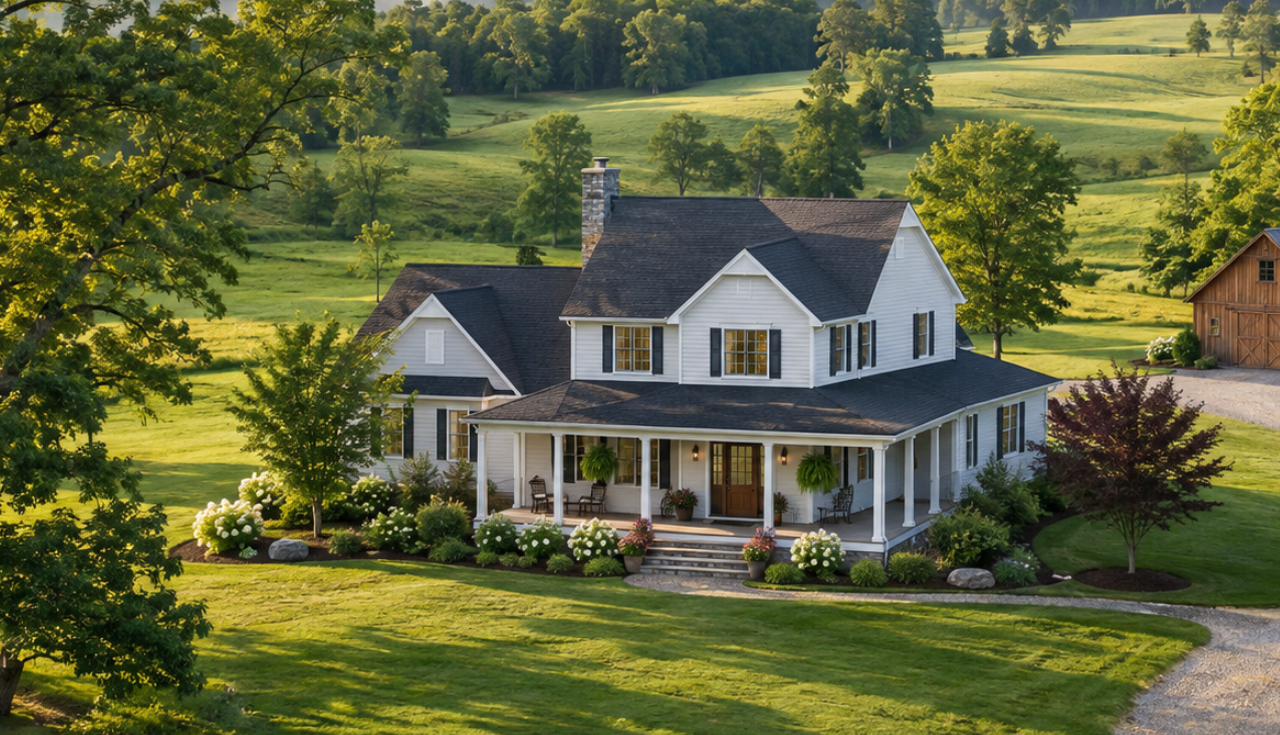
A buyer wants 40 acres, a farmhouse, and a barn. A lender declines because of the acreage, and the broker assumes the property cannot be financed. That assumption is often wrong, because acreage limits vary by lender and program, and the property’s use matters more than the number.
At LendSure Mortgage Corp., we are a flexible non-QM lender that finances large-acreage residential properties, including those over 20 acres that many lenders decline. Submit your scenario and we’ll provide a pre-qualification within 24 hours.
What Is an Acreage Loan?
An acreage loan finances a residence with substantial surrounding land. It differs from loans for vacant land, working farms, and new construction.
| Loan Type | What It Finances |
| Residential acreage | An existing home with substantial surrounding land |
| Vacant land | Undeveloped property with no residence |
| Agricultural | Property used primarily for a farming or ranching business |
| Construction | A new home on a lot ready to build |
For construction, our Ground-Up Construction program finances lots that are ready to go vertical, with utilities to the site.
How Many Acres Can You Finance With a Mortgage?
There is no single acreage threshold that applies everywhere. Some lenders set their own limits, while others review large parcels individually. A decline often reflects one lender’s overlay rather than a property that cannot be financed.
Acreage alone rarely decides the outcome. Residential use, appraisal support, and recorded restrictions often matter more.
Why a 40-Acre Property May Be Easier to Finance Than a 20-Acre Property
| 40-Acre Property | 20-Acre Property | |
| Use | Residence with recreational land | Residence with active farming income |
| Comparable sales | Rural homes with similar acreage have sold nearby | Few residential comparables |
| Recorded restrictions | None affecting residential use | Conservation easement limits use |
| Likely path | May fit residential financing | Needs closer review or a different program |
Neither property is automatically eligible or ineligible. The details decide.
How Does Acreage Affect Property Valuation?
Value Does Not Scale With Acres
The Appraisal Institute’s Rural Property Valuation text frames rural valuation around property rights, site improvements, market analysis, and highest and best use. That is why acreage cannot be valued by multiplying acres by one price. A 50-acre property may not carry 2.5 times the land value of a 20-acre property when some land has limited utility or the local market pays little extra for larger parcels.
Evaluate the property’s supported market value rather than assuming each added acre adds proportional collateral.
Excess Land and Surplus Land
Appraisers also distinguish excess land from surplus land, concepts that sit within the Appraisal Institute’s residential site valuation coursework. Both concern valuation, not how many acres a lender will finance.
| Land Type | Meaning | Why It Matters |
| Excess land | Land that may have a separate highest and best use and could be separated from the property | May need distinct valuation |
| Surplus land | Land not needed for the improvements that lacks an independent use | May add value without being independently developable |
Ask whether additional land has independent development potential or mainly supports the residence.
How Does Land Use Affect Acreage Financing?
The REALTORS® Land Institute and NAR Land Market Survey tracks residential, recreational, ranch, industrial, and other land categories separately. Its 2025 report found land sales up 0.8%, with ranch land prices up 2.2% and recreational land up 1.9%. These are national land-market indicators, not mortgage approval figures.
Two 40-acre properties can finance differently. A residence with recreational land is a different file from a parcel used mainly for commercial agriculture, so identify the primary use before choosing a program.
Outbuildings
A detached garage or hobby barn typically fits residential use, while a large livestock facility or silo may point to agricultural use. Lender treatment varies. Ask for photos and a description of every significant structure before ordering the appraisal.
Conservation Easements and Recorded Restrictions
The Land Trust Alliance describes conservation easements as legal agreements that restrict certain land uses and stay with the property after ownership changes. Depending on the terms, they can limit development, subdivision, or construction.
A borrower buying 60 acres with an existing home may find 35 acres under an easement. The property may still suit residential financing, but valuation, marketability, and lender acceptance can change. Review recorded restrictions before treating development potential as value.
Water Rights and Surveys
Water Rights
A 2026 American Bar Association article notes that water rights are governed primarily by state law and vary by jurisdiction, and that the type of right tied to a parcel matters. Owning land does not establish ownership of every associated water right.
Separate household drinking water from irrigation or agricultural rights. When a 35-acre property’s value depends partly on irrigation, verify which rights transfer and how they are documented.
Legal Description and Survey
Advertised acreage, public-record acreage, and surveyed acreage can differ. Confirm the legal description and any survey before submitting an unusual acreage property, since the collateral is the legally described parcel.
Scenario: A 45-Acre Home That Exceeds One Lender’s Limits
A borrower wants a $625,000 home on 45 acres with a primary residence, recreational land, a detached workshop, and a small barn. A lender declines because the property exceeds its acreage limit.
Before submitting elsewhere, the broker should investigate:
- Whether another lender accepts 45-acre residential properties
- Whether the property’s primary use is residential
- How the land and outbuildings contribute to appraised value
- Whether recorded restrictions limit development
- Whether the lender accepts the zoning classification
- Whether comparable sales support the valuation
How We Approach Large-Acreage Financing
Our programs support large-acreage residential properties that fall outside standard guidelines. Income documentation options include Full Doc, Bank Statement, DSCR, and Asset Qualifier. We apply common-sense underwriting to residential use, comparable sales, improvements, and collateral profile rather than a blanket acreage cutoff.
Gather the property address and acreage, zoning and actual use, any income-producing land, outbuildings with photos, recorded restrictions, water and survey information, parcel count, and the reason another lender declined.
Ready to Structure an Acreage Loan?
A strong borrower on a large rural property is not necessarily a declined file. Submit your scenario with the property details and we’ll help determine the right structure. Become an approved broker to access our full program suite and broker resources.
Frequently Asked Questions
Can adjacent parcels be financed together as one acreage property?
Adjacent parcels can be financed together when title, lien position, zoning, and contiguity requirements are satisfied under the lender’s guidelines. Each parcel’s legal description and ownership must be reviewed. Disclose the parcel count at submission, since title problems found late can delay closing.
Can land the borrower already owns count toward a ground-up build?
Yes, land equity counts toward the cost basis on our Ground-Up Construction loans. We can advance up to 65% of the lot’s value at closing, which can cover closing costs and start the project. The lot must be ready to go vertical.
Can a manufactured or modular home be built on acreage with a ground-up loan?
No, our Ground-Up Construction program does not finance manufactured or modular homes. The program covers one to four unit site-built projects, and spec builds and build-to-rent are permitted.
Does ground-up financing allow an owner-builder?
Yes, owner-builders are allowed. We verify experience through chain of title and project documents, so completed builds must be in the borrower’s own name or LLC’s name to count.
Can a self-employed borrower buy acreage with bank statements?
Yes, our Bank Statement program qualifies self-employed borrowers on 12 or 24 months of deposits. We apply a variable expense factor from 10% to 90% based on the borrower’s business, a CPA letter is not required for lower factors, and a one to two page self-employed questionnaire replaces narrative letters.
Can subdivision potential be counted toward a propertys value?
Not by assumption. The appraiser determines what the market supports, and zoning or recorded restrictions can limit subdivision. Confirm both before presenting development potential as part of the collateral.
What if a survey shows less acreage than the listing advertised?
The collateral is the legally described parcel, not the advertised acreage. A discrepancy usually needs resolution before closing, whether through a corrected legal description, a boundary agreement, or a renegotiated price. Raise survey questions early so the lender reviews the correct parcel.