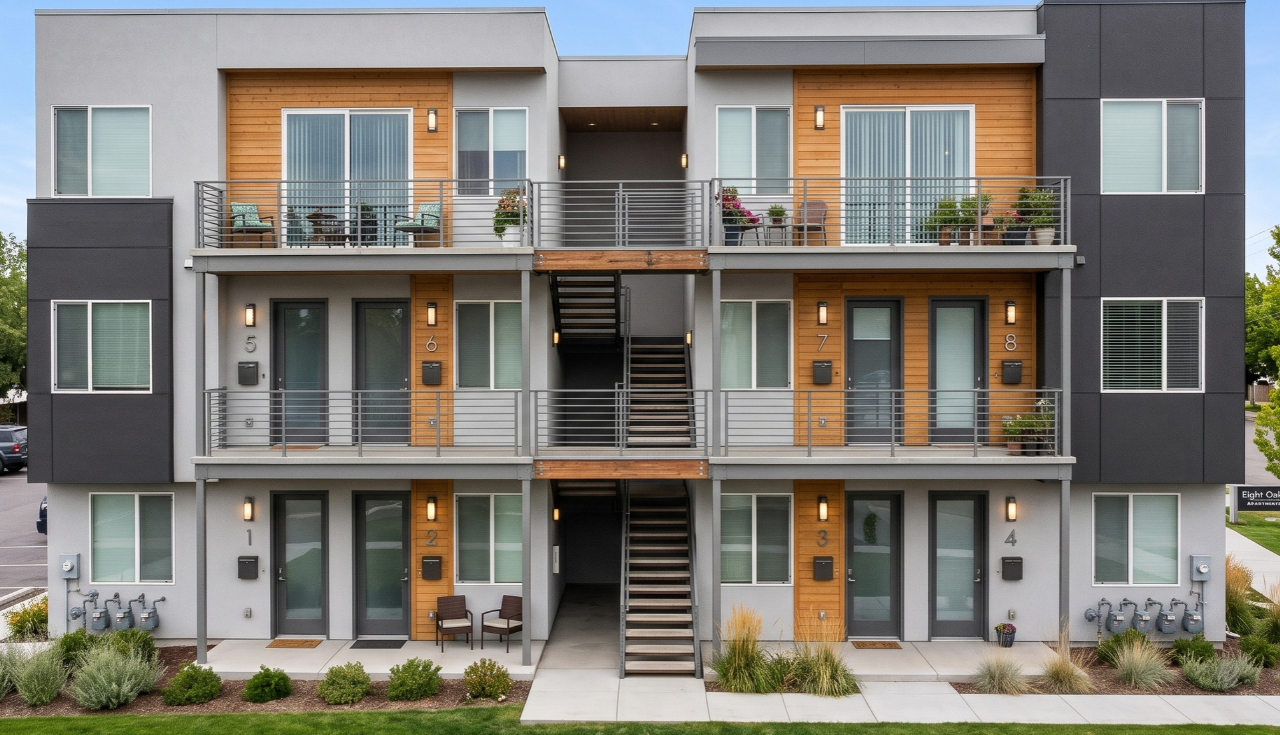
An investor who has successfully built a portfolio of duplexes and fourplexes eventually asks about the next step. A six-unit building. An eight-plex. A small apartment building. The instinct is to approach it the same way as the last deal. That instinct is wrong. The fifth unit is not just one more door. It crosses a financing threshold that changes how the property is underwritten, valued, and documented.
At LendSure Mortgage Corp., our DSCR program supports 5–10 unit properties with no personal income documentation required.
Submit your scenario and we’ll provide a pre-qualification within 24 hours. Our webinar Everything You Need to Know About Funding 5–10 Unit Properties covers the full financing structure.

Why Financing Changes at Five Units
The CFPB defines a multifamily dwelling as a property containing five or more individual dwelling units. FHFA classifies properties with 5–50 units as small multifamily, a distinct segment with its own financing considerations. These are not arbitrary lending preferences. They reflect how federal housing policy and secondary-market infrastructure treat the property type.
A fourplex sits inside the 1–4-unit residential mortgage framework. A five-unit building does not. That single unit moves the property into multifamily territory, where underwriting places significantly more weight on the property’s income-producing performance and less on the borrower’s personal income alone.
Is a 5–10 Unit Building Residential or Commercial?
It Depends on the Context
Borrowers often encounter conflicting terminology: commercial mortgage, commercial multifamily, residential multifamily, small-balance commercial loan. The confusion is understandable because these terms are used in different legal, tax, and lending contexts.
For federal tax depreciation purposes, IRS Publication 946 classifies a building as residential rental property when 80% or more of gross rental income comes from dwelling units, with a 27.5-year recovery period. A 6-unit apartment building can still qualify as residential rental property under that IRS definition even though it crosses the 5-unit multifamily threshold used in mortgage contexts.
The “Missing Middle” of Investment Financing
Freddie Mac research on small multifamily properties identified a structural gap: 5–50 unit properties are too large for standard 1–4-unit residential financing but still far smaller than institutional apartment complexes. Lending availability for this segment has historically been inconsistent across lenders and regions. That gap is exactly where brokers with non-QM access can differentiate themselves.
How Lenders Qualify a 5–10 Unit Property
The Property’s Economics Come First
Once a property reaches five units, the underwriting focus shifts toward property-level performance. Fannie Mae’s Small Mortgage Loan Program covers existing, stabilized multifamily properties at five or more units and evaluates them on DSCR and LTV — illustrating how established multifamily underwriting frameworks approach the property’s income before the borrower’s personal finances.
HUD’s Section 223(f) program similarly requires that project income be sufficient to repay the loan after necessary operating expenses are considered. The logic is the same: it is not enough that the property collects rent. What matters is how much income remains after vacancy, taxes, insurance, maintenance, management, and other operating costs are deducted.
A Worked Example
Here is how lenders move from rent roll to loan decision on an 8-unit building:
| Step | Figure |
| 8 units at $1,500/month average | $144,000 gross potential annual rent |
| Less 5% vacancy and collection loss | ($7,200) |
| Less annual operating expenses (taxes, insurance, maintenance, management) | ($36,000) |
| Net Operating Income | $100,800 |
| Annual debt service on $900,000 loan at current rates | ~$72,000 |
| DSCR | $100,800 / $72,000 = 1.40x |
Our DSCR program accepts ratios as low as 1.0x for 5–10-unit properties, with no personal income documentation required. The property’s income is the primary qualifying metric.
LendSure’s Program for 5–10 Unit Properties
Our DSCR program supports 5–10 unit properties with loan amounts up to $3,000,000 and no personal income verification. Key terms:
- Purchase LTV: up to 75%
- Rate and term refinance LTV: up to 70%
- Cash-out refinance LTV: up to 65%
- Minimum DSCR: 1.0x (below 1.0x requires senior management review)
- Minimum FICO: 660
- Cash-out: up to $500,000
- LLC and trust vesting: compatible
- Multiple loans: up to 10 loans per investor simultaneously
DSCR is calculated using gross rents with no vacancy deduction applied at our level. When a borrower provides leases and two months of payment receipts showing rents above the appraiser’s rent estimate, the higher figure may be used.
Stabilized vs. Unstabilized Properties
Financing an Occupied Building
A 5–10 unit property at or near full occupancy with a documented rent roll and operating history is a stabilized acquisition or refinance. This is the standard scenario our DSCR program is designed for. The rent roll, current leases, and, if available, a trailing 12-month operating statement are the core documents needed.
When the Property Needs Work
A building with significant vacancies or deferred maintenance is a different scenario. Permanent DSCR financing is best suited to properties generating stable income. If the property requires renovation and lease-up before it reaches stabilization, the financing need is different: a bridge or construction product to stabilize the asset, followed by a DSCR refinance once the building is performing.
Our Ground-Up Construction program and BOOST Bridge Loan can serve different stages of that strategy.
Investor Goals and Financing Scenarios
| Investor’s Goal | Financing Approach |
| Acquire occupied 6–10 unit building | DSCR acquisition loan |
| Refinance existing 5–10 unit property | DSCR rate-and-term or cash-out refi |
| Pull equity to fund next acquisition | DSCR cash-out refinance (up to $500K) |
| Buy 8-unit building needing renovation | Bridge loan to stabilize, then DSCR refi |
| Scale from fourplexes to first 5-unit | DSCR with investor experience from 1–4 unit portfolio |
| Hold multiple 5–10 unit buildings | Up to 10 simultaneous DSCR loans per investor |
Does Borrower Experience Matter?
Investor experience can be relevant on 5–10 unit scenarios, particularly for first-time multifamily borrowers. An investor who already owns and manages several 1–4-unit rental properties brings demonstrated operational experience that translates to small multifamily. That existing track record, documented through their real estate portfolio, supports the underwriting picture even when the 5–10-unit building is their first entry into this size range.
Brokers should document the borrower’s existing rental portfolio and management history at submission. If the investor has managed fewer total units than the target property, noting any property management arrangements is also helpful. Fannie Mae’s multifamily guide notes that borrower experience may be considered for certain small multifamily transactions, and this consideration applies across market-rate programs generally.
What to Submit for a 5–10 Unit Scenario
Before reaching out to your account executive, gather the following:
- Property address and unit count
- Current rent roll showing each unit, lease terms, and monthly rent
- Occupancy rate and any known vacancies
- Operating statement or trailing 12-month income and expense history
- Purchase price or current estimated value
- Requested loan amount
- Investor’s existing rental property portfolio and entity information
- Purchase, refinance, or cash-out objective
A complete submission package moves faster at pre-qualification and reduces back-and-forth during underwriting. The rent roll and operating statement are the two documents most likely to affect how quickly the file can be assessed.
Ready to Structure a 5–10 Unit Loan?
A strong-performing small multifamily property is a highly financeable asset when submitted to the right lender. Submit your scenario with the rent roll, operating history, and property details and our team will help determine the right structure. Become an approved broker to access our full program suite and broker resources.
Frequently Asked Questions
Why cant a 5-unit property be financed like a fourplex?
A four-unit property sits inside the 1–4-unit residential mortgage framework and can be eligible for conforming financing under Fannie Mae, Freddie Mac, and FHA guidelines. A five-unit property crosses into multifamily classification under federal definitions, including CFPB’s HMDA framework and FHFA’s housing goals. That reclassification changes the available loan products, underwriting methodology, and documentation requirements.
Is a 5–10 unit building considered commercial?
That depends on the context. For federal tax depreciation purposes, an apartment building generating at least 80% of its rental income from dwelling units is classified as residential rental property under IRS Publication 946. For mortgage purposes, it is multifamily. Borrowers should not assume “multifamily” and “commercial” mean the same thing across every context.
Does personal income matter for a 5–10 unit DSCR loan?
No. Our DSCR program for 5–10 unit properties requires no personal income documentation. Qualification is based on the property’s rental income relative to its debt service. Personal credit and reserves are still evaluated, but W-2s, tax returns, or pay stubs are not required.
What DSCR is required for a 5–10 unit property?
Our program accepts DSCR as low as 1.0x. Ratios below 1.0x require senior management review and are evaluated case by case. DSCR is calculated using the property’s gross rents with no vacancy deduction applied at our level.
Can an investor finance multiple 5–10 unit properties simultaneously?
Yes. We can close up to 10 loans for a single investor simultaneously. Investors are not required to pay off or sell one property before acquiring another. Each property is evaluated independently on its own cash flow.
What LTV is available on a 5–10 unit purchase?
Purchase LTV goes up to 75%. Rate-and-term refinance LTV goes up to 70%, and cash-out refinance LTV goes up to 65% with cash-out up to $500,000. Minimum FICO is 660.
Can the property be held in an LLC or trust?
Yes. Our DSCR program is compatible with LLC and trust vesting, which is common among investors building multifamily portfolios.
What if the property has vacancies?
Current vacancies affect the DSCR calculation and should be disclosed at submission. Our program is designed for stabilized or near-stabilized properties. A building with significant vacancies or deferred maintenance may be better suited for a bridge loan to achieve stabilization before moving into permanent DSCR financing.